[Go] Slice와 Array 차이 이해하기
메모리 공부를 하다가 문득 궁금해졌다. Go에서의 Slice와 Array는 어떻게 다른가?
1
2
3
4
5
6
7
8
9
10
11
12
13
14
15
16
17
18
19
20
21
22
23
24
25
26
27
28
29
30
31
32
package main

import "unsafe"

func main() {
	numSlice1 := make([]int, 2, 4)
	numSlice2 := make([]int, 2)
	numSlice3 := []int{1, 2}
	numSlice4 := make([]int, 0, 256)
	slices := [][]int{numSlice1, numSlice2, numSlice3, numSlice4}

	numArray := [2]int{1, 2}

	println("=== 배열 ===")
	println("변수 주소:", &numArray)
	println("첫 원소 주소:", &numArray[0])
	println("배열 크기:", unsafe.Sizeof(numArray), "bytes")

	println("\n=== 슬라이스 ===")
	println("슬라이스0 변수 주소:", &numSlice1)
	println("슬라이스1 변수 주소:", &numSlice2)
	println("슬라이스2 변수 주소:", &numSlice3)
	println("슬라이스3 변수 주소:", &numSlice4)

	for i, s := range slices {
		println("\n=== 슬라이스", i, "===")
		println("슬라이스", i, "헤더 크기:", unsafe.Sizeof(s), "bytes")
		println("슬라이스", i, "backing array 시작 주소:", unsafe.SliceData(s))
		println("슬라이스", i, "len:", len(s), "cap:", cap(s))
		println("슬라이스", i, "backing array 크기", unsafe.Sizeof(s[0])*uintptr(cap(s)), "bytes")
	}
}
가장 큰 차이점은 slice는 대괄호로만 표현되고, array는 대괄호 안에 배열의 크기를 함께 선언한다는 것이다. array는 익숙한 그 녀석이다. 연속된 메모리에 값을 저장하고 있는 자료형. slice는 사실 array, len, cap을 들고 있는 구조체다.
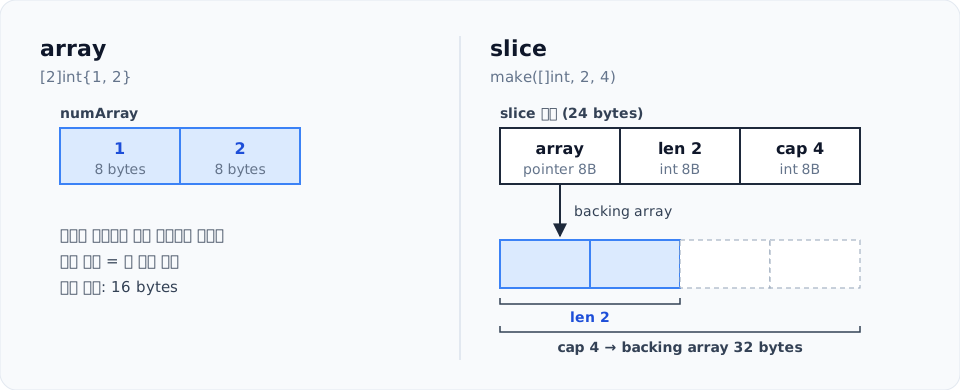 array는 값을 그 자리에, slice는 backing array를 가리키는 헤더를 들고 있다
이 특성을 알고 탐구를 시작하자. 이렇게 할당되었을 때 각 변수의 메모리 할당 상태를 알아보자.
1
2
3
4
5
6
7
8
9
10
11
12
13
14
15
16
17
18
19
20
21
22
23
24
25
26
27
28
29
30
31
32
33
34
=== 배열 ===
변수 주소: 0x7eea3da9a600
첫 원소 주소: 0x7eea3da9a600
배열 크기: 16 bytes

=== 슬라이스 ===
슬라이스0 변수 주소: 0x7eea3da9aea8
슬라이스1 변수 주소: 0x7eea3da9ae90
슬라이스2 변수 주소: 0x7eea3da9ae78
슬라이스3 변수 주소: 0x7eea3da9ae60

=== 슬라이스 0 ===
슬라이스 0 헤더 크기: 24 bytes
슬라이스 0 backing array 시작 주소: 0x7eea3da9ae38
슬라이스 0 len: 2 cap: 4
슬라이스 0 backing array 크기 32 bytes

=== 슬라이스 1 ===
슬라이스 1 헤더 크기: 24 bytes
슬라이스 1 backing array 시작 주소: 0x7eea3da9ae28
슬라이스 1 len: 2 cap: 2
슬라이스 1 backing array 크기 16 bytes

=== 슬라이스 2 ===
슬라이스 2 헤더 크기: 24 bytes
슬라이스 2 backing array 시작 주소: 0x7eea3da9ae18
슬라이스 2 len: 2 cap: 2
슬라이스 2 backing array 크기 16 bytes

=== 슬라이스 3 ===
슬라이스 3 헤더 크기: 24 bytes
슬라이스 3 backing array 시작 주소: 0x7eea3da9a618
슬라이스 3 len: 0 cap: 256
슬라이스 3 backing array 크기 2048 bytes
array와 cap이 2로 생성된 slice들은 그 크기가 16 bytes이다. slice는 array, len, cap을 담고 있었는데 각각 8 bytes씩(pointer, int, int) 차지하므로 slice 헤더 크기가 24 bytes이다. slice의 cap만큼 slice.array의 크기가 할당되어 있다.
slice 할당에서 재미있는 점은 slice0 → slice3으로 갈수록 slice 변수 주소가 큰 위치에서 -24씩 감소한다는 것이다. 즉 스택 영역에 할당되는 것이 아닐까 유추해볼 수 있다. slice0.array → slice1.array → slice2.array의 시작 주소도 backing array의 크기만큼 차이 난다. 크기가 큰 slice3.array(2048 bytes)는 떨어진 위치(배열 바로 뒤)에 있다.
두 가지 실험을 해보자.
slice.cap이상으로 인자를 넣는 경우 메모리는 어떻게 되는가- 다른 함수에서 슬라이스를 생성하고 반환하는 경우 메모리는 어떻게 되는가
1
2
3
4
5
6
7
8
9
10
11
12
13
14
15
16
17
18
19
20
21
package main

import "unsafe"

func main() {
	slice1 := []int{1, 2}
	slice2 := []int{3, 4}

	println("slice1 array addr:", unsafe.SliceData(slice1))
	println("slice2 array addr:", unsafe.SliceData(slice2))

	slice1 = append(slice1, slice2...)

	println("slice1 array addr:", unsafe.SliceData(slice1))
	println("slice2 array addr:", unsafe.SliceData(slice2))

	slice2 = append(slice2, slice2...)

	println("slice1 array addr:", unsafe.SliceData(slice1))
	println("slice2 array addr:", unsafe.SliceData(slice2))
}
1
2
3
4
5
6
slice1 array addr: 0xf88276e4708
slice2 array addr: 0xf88276e46f8
slice1 array addr: 0xf88276a20e0
slice2 array addr: 0xf88276e46f8
slice1 array addr: 0xf88276a20e0
slice2 array addr: 0xf88276a2100
slice.cap 이상으로 값을 넣었더니 어딘가 멀~리에 새로 할당되었다. 다른 slice도 array를 새로 할당할 때 붙여서 만들어졌다. 근데 이게 스택을 뜻하는 건 아니다.
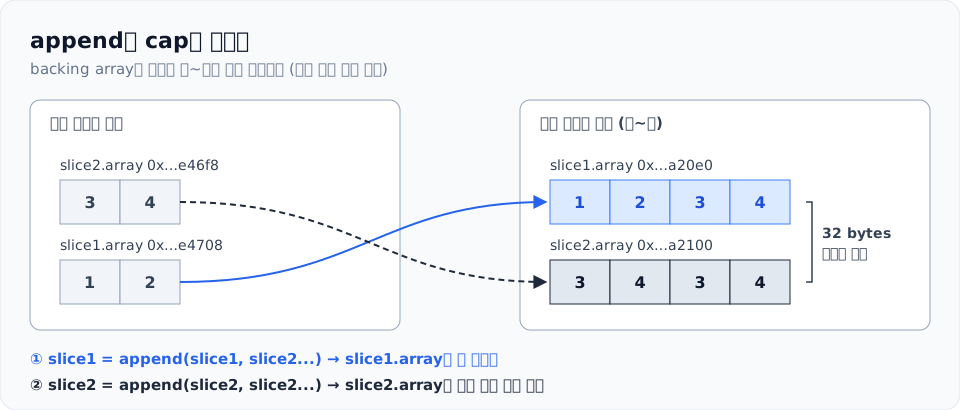 cap을 넘긴 append 전후 backing array 위치
1
2
3
4
5
6
7
8
9
10
11
12
13
14
15
16
17
18
19
20
21
22
23
24
25
26
27
28
func growslice(oldPtr unsafe.Pointer, newLen, oldCap, num int, et *_type) slice {
	// ...

	var p unsafe.Pointer
	if !et.Pointers() {
		p = mallocgc(capmem, nil, false)
		// The append() that calls growslice is going to overwrite from oldLen to newLen.
		// Only clear the part that will not be overwritten.
		// The reflect_growslice() that calls growslice will manually clear
		// the region not cleared here.
		memclrNoHeapPointers(add(p, newlenmem), capmem-newlenmem)
	} else {
		// Note: can't use rawmem (which avoids zeroing of memory), because then GC can scan uninitialized memory.
		p = mallocgc(capmem, et, true)
		if lenmem > 0 && writeBarrier.enabled {
			// Only shade the pointers in oldPtr since we know the destination slice p
			// only contains nil pointers because it has been cleared during alloc.
			//
			// It's safe to pass a type to this function as an optimization because
			// from and to only ever refer to memory representing whole values of
			// type et. See the comment on bulkBarrierPreWrite.
			bulkBarrierPreWriteSrcOnly(uintptr(p), uintptr(oldPtr), lenmem-et.Size_+et.PtrBytes, et)
		}
	}
	memmove(p, oldPtr, lenmem)

	return slice{p, newLen, newcap}
}
slice의 크기가 커져야 될 땐 runtime.growslice()를 호출한다. 함수 구현 마지막을 보면 mallocgc()를 호출한다. slice가 grow될 땐 heap 영역에 array가 할당된다. 주소가 붙어 있는 건 Go 할당기가 같은 크기 클래스(여기선 32 bytes) 객체를 한 span에서 차례로 나눠주기 때문이라고 한다.
Go 프로그램을 실행할 때 -gcflags='-m=2' 옵션을 붙이면 컴파일러 메시지를 볼 수 있다.
1
2
3
4
5
6
7
8
9
10
11
12
13
14
15
16
17
18
package main

import "unsafe"

//go:noinline
func genSlice() []int {
	return []int{1, 2}
}

func main() {
	s1 := []int{1, 2}
	s2 := genSlice()
	s3 := make([]int, 100000)

	println("slice array addr:", unsafe.SliceData(s1))
	println("slice array addr:", unsafe.SliceData(s2))
	println("slice array addr:", unsafe.SliceData(s3))
}
1
2
3
4
5
6
7
8
9
10
11
12
13
14
15
16
17
18
19
//go:noinline 없이
# command-line-arguments
./slice-func.go:6:6: can inline genSlice with cost 5 as: func() []int { return []int{...} }
./slice-func.go:10:6: can inline main with cost 37 as: func() { s1 := []int{...}; s2 := genSlice(); s3 := make([]int, 100000); println("slicearray addr:", <node unsafe.SliceData>); println("slice array addr:", <node unsafe.SliceData>); println("slice array addr:", <node unsafe.SliceData>) }
./slice-func.go:12:16: inlining call to genSlice
./slice-func.go:7:14: []int{...} escapes to heap in genSlice:
./slice-func.go:7:14:   flow: ~r0 ← &{storage for []int{...}}:
./slice-func.go:7:14:     from []int{...} (spill) at ./slice-func.go:7:14
./slice-func.go:7:14:     from return []int{...} (return) at ./slice-func.go:7:2
./slice-func.go:7:14: []int{...} escapes to heap
./slice-func.go:13:12: make([]int, 100000) escapes to heap in main:
./slice-func.go:13:12:   flow: {heap} ← &{storage for make([]int, 100000)}:
./slice-func.go:13:12:     from make([]int, 100000) (too large for stack) at ./slice-func.go:13:12
./slice-func.go:11:13: []int{...} does not escape
./slice-func.go:12:16: []int{...} does not escape
./slice-func.go:13:12: make([]int, 100000) escapes to heap
slice array addr: 0x435082516710
slice array addr: 0x435082516700
slice array addr: 0x435082600000
1
2
3
4
5
6
7
8
9
10
11
12
13
14
15
16
17
//go:noinline 함께
# command-line-arguments
./slice-func.go:6:6: cannot inline genSlice: marked go:noinline
./slice-func.go:10:6: cannot inline main: function too complex: cost 89 exceeds budget 80
./slice-func.go:7:14: []int{...} escapes to heap in genSlice:
./slice-func.go:7:14:   flow: ~r0 ← &{storage for []int{...}}:
./slice-func.go:7:14:     from []int{...} (spill) at ./slice-func.go:7:14
./slice-func.go:7:14:     from return []int{...} (return) at ./slice-func.go:7:2
./slice-func.go:7:14: []int{...} escapes to heap
./slice-func.go:13:12: make([]int, 100000) escapes to heap in main:
./slice-func.go:13:12:   flow: {heap} ← &{storage for make([]int, 100000)}:
./slice-func.go:13:12:     from make([]int, 100000) (too large for stack) at ./slice-func.go:13:12
./slice-func.go:11:13: []int{...} does not escape
./slice-func.go:13:12: make([]int, 100000) escapes to heap
slice array addr: 0x5d165fbac708
slice array addr: 0x5d165fc14000
slice array addr: 0x5d165fc80000
inline은 잠깐 무시하고, 컴파일러는 변수가 함수 밖으로 나가는지 미리 확인할 수 있다. 함수 밖으로 나가지 않는다면 스택에 할당할 수 있다. 100%는 아니다. 예시로 크기가 큰 값은 스택에 할당하지 않고 힙에 할당한다.
함수에 //go:noinline 옵션을 붙여두었다. 붙이지 않고 실행한 결과(위)는 함수를 main 안에 넣으면서 does not escape가 되었다. 옵션을 붙이고 실행하면(아래) inline을 명시적으로 하지 않으면서 escapes to heap이 나온 것을 확인할 수 있다.
단, 이는 표현식이 탈출하느냐 아니냐를 판단하는 요소이지 정확하게 스택, 힙 중 어디에 할당되었음을 나타내진 않는다.
마지막으로 재미있는 규칙을 하나 살펴보자.
1
2
3
4
5
6
7
8
9
10
11
12
13
14
15
16
17
18
19
20
21
22
23
24
25
26
27
28
29
30
31
32
33
34
// nextslicecap computes the next appropriate slice length.
func nextslicecap(newLen, oldCap int) int {
	newcap := oldCap
	doublecap := newcap + newcap
	if newLen > doublecap {
		return newLen
	}

	const threshold = 256
	if oldCap < threshold {
		return doublecap
	}
	for {
		// Transition from growing 2x for small slices
		// to growing 1.25x for large slices. This formula
		// gives a smooth-ish transition between the two.
		newcap += (newcap + 3*threshold) >> 2

		// We need to check `newcap >= newLen` and whether `newcap` overflowed.
		// newLen is guaranteed to be larger than zero, hence
		// when newcap overflows then `uint(newcap) > uint(newLen)`.
		// This allows to check for both with the same comparison.
		if uint(newcap) >= uint(newLen) {
			break
		}
	}

	// Set newcap to the requested cap when
	// the newcap calculation overflowed.
	if newcap <= 0 {
		return newLen
	}
	return newcap
}
새 len과 원래 cap을 비교한다.
- 원래 cap을 두 배 해도 부족하면, 필요한 새 len을 새 cap으로 설정한다.
- 원래 cap이 256보다 작으면 원래 cap을 두 배 한 걸 새 cap으로 설정한다.
- 원래 cap이 256 이상이면
newcap += (newcap + 3*threshold) >> 2를 새 len 이상이 될 때까지 반복한다.
이 수식을 해석해보자면, 새 cap은 newcap + newcap/4 + 192이다. 기존 값에 25%를 더하고 192 상수를 더하는 건데, cap의 크기가 작을 때는 192의 영향이 크지만 점점 커지면 192의 영향이 줄어든다. 값이 커질수록 증가 비율이 1.25배에 수렴하게 된다.
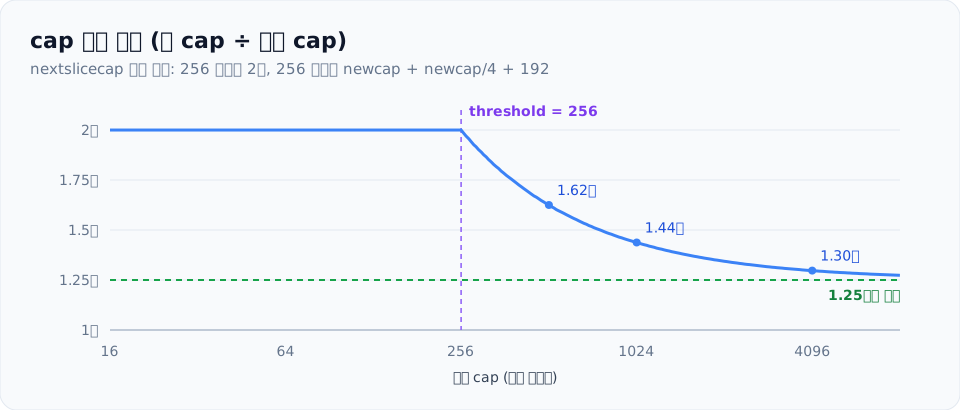 원래 cap에 따른 cap 증가 비율 (nextslicecap 공식 기준)